Home › Products › Cardiology › Caprin 5000IU Injection
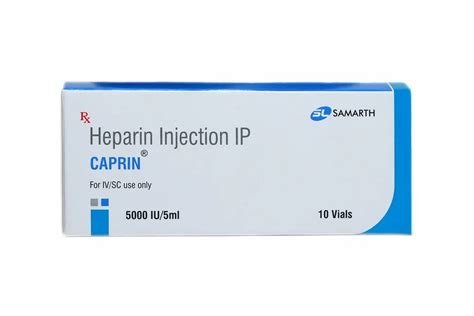
Caprin 5000IU Injection
Salt Composition: HEPARIN
- Manufacturer: SAMARTH LIFE SCIENCES PVT LTD
- Pack Size: 1 VIAL(s) OF 5ML
- Dosage Form: INJECTION
- Strength: 5000IU
- Prescription Required
- Storage: Store at room temperature, between 20°C to 25°C (68°F to 77°F). Keep away from moisture, heat, and light. It should not be frozen. Keep away from children and pets.
₹92.00₹113.27
Inclusive of all taxes
Product Introduction
Caprin 5000IU Injection contains Heparin as its active component. Heparin is an anticoagulant medication that prevents the formation of blood clots. It is prescribed across various clinical scenarios to reduce the risk of clotting, particularly in patients at elevated risk of developing blood clots. Caprin 5000IU Injection is used in hospital settings to prevent and treat deep vein thrombosis (DVT), pulmonary embolism (PE), and other conditions where blood clot formation is a concern. It is also administered during certain surgical procedures and in dialysis to prevent clotting in the extracorporeal circuit. Response to treatment varies among individuals, so administration requires careful monitoring of blood clotting parameters, typically through the activated partial thromboplastin time (aPTT) test. Dosage may require adjustment to maintain therapeutic levels. In case of excessive bleeding or overdose, the effects of Caprin 5000IU Injection can be reversed using protamine sulfate, which acts as an antidote to this medication. Patients with known hypersensitivity or allergic reactions should not use Caprin 5000IU Injection. Although this medication is generally safe, it may not be appropriate for patients with certain medical conditions, such as bleeding disorders or recent major surgeries. You must inform your healthcare provider about any existing medical conditions and medications you are currently taking before beginning therapy. Elderly individuals may experience greater susceptibility to bleeding complications, and lower dosages or closer monitoring may be necessary. Impaired liver or kidney function can affect the metabolism and elimination of this medication, potentially leading to adverse effects. Dosing adjustments may be necessary for patients with these conditions.
Uses
Caprin 5000IU Injection is used to treat the following: Deep vein thrombosis Pulmonary embolism Disseminated intravascular coagulation Venous thromboembolism prophylaxis Atrial fibrillation with a high risk of stroke Hemodialysis Pregnancy-related thrombosis
How it works
Caprin 5000IU Injection enhances the activity of antithrombin III, a natural anticoagulant protein in the body. By binding to antithrombin III, this medication accelerates its inhibitory effect on clotting factors, particularly thrombin and factor Xa. This inhibition disrupts the blood coagulation cascade, preventing fibrin formation, an essential component of blood clots. As a result, this medication effectively reduces the risk of clot formation and growth, making it a valuable anticoagulant used in various medical conditions.
How to Use
Caprin 5000IU Injection is typically administered by injection either intravenously (IV) or subcutaneously (under the skin). The specific dosage and administration method depends on the medical condition being treated, the patient's weight, age, and other factors, which a healthcare professional should determine. For IV use, this medication is usually given in a hospital setting under continuous monitoring to adjust the dosage as needed. Subcutaneous injections are often used for prophylactic purposes or in outpatient settings.
Side Effects
Caprin 5000IU Injection causes some side effects like all medications, although not everyone will experience them. Serious: Severe allergic reactions, including rash, itching, swelling, severe dizziness, or difficulty breathing Bleeding Caprin 5000IU Injection-induced thrombocytopenia (HIT) Osteoporosis (bone weakness) Common: Bruising Hematomas Pain at Injection Site Redness at Injection Site Elevated Liver Enzymes Fever Nausea Vomiting
Expert Tips
Patients should inform their healthcare providers about their medical history, including any bleeding disorders, liver or kidney problems, recent surgeries, and allergies, to determine the appropriate dosage and administration method. Regular monitoring of blood clotting parameters, such as activated partial thromboplastin time (aPTT) or anti-Xa assay, is crucial to maintain the desired anticoagulant effect and prevent bleeding or thrombosis. Patients should follow the prescribed dosage and administration instructions precisely and report any unusual bleeding, bruising, or allergic reactions promptly. It is advisable to avoid activities or medications that may increase the risk of bleeding while on Caprin 5000IU Injection. By adhering to these instructions and maintaining open communication with healthcare providers, patients can minimize risks and maximize the benefits of this therapy.
References
- Wockhardt UK Ltd, Electronic medicines compendium (EMC), [Revised on June 2018] [ Accessed on 30th July 2023], https://www.medicines.org.uk/emc/files/pil.1678.pdf
- Baxter Healthcare Corporation, US Food, and Drug Administration, [Accessed on 30th July 2023], https://www.accessdata.fda.gov/drugsatfda_docs/label/2006/017037s158lbl.pdf
- KD Tripathi, Essentials of Medical Pharmacology, Drugs affecting coagulation, bleeding, and thrombosis, 7th edition, 2013, 617
Safety Advice
Pregnancy: safe Caprin 5000IU Injection is generally considered safe to use during pregnancy, and it is often preferred over certain other anticoagulants, especially vitamin K antagonists like warfarin. This preference is due to its minimal placental transfer, which means it does not cross the placenta to a significant extent and has a lower risk of harming the developing fetus.
Lungs: safe Caprin 5000IU Injection is generally safe for the lungs, as it is an anticoagulant primarily used to prevent and treat blood clots in the circulatory system, not the lungs directly. It is often used to treat conditions like pulmonary embolism (PE), where blood clots block blood flow to the lungs.
Breastfeeding: Consult your doctor While Caprin 5000IU Injection is considered safe during breastfeeding, as with any medication, nursing mothers need to discuss their specific situation with a healthcare provider.
Disclaimer
The information provided on this page is intended for general informational purposes only and should not be considered as medical advice. Always consult a qualified healthcare professional before starting, stopping, or changing any medication. Self-medication can be harmful. Med For Rare does not endorse self-diagnosis or self-treatment.